short answer
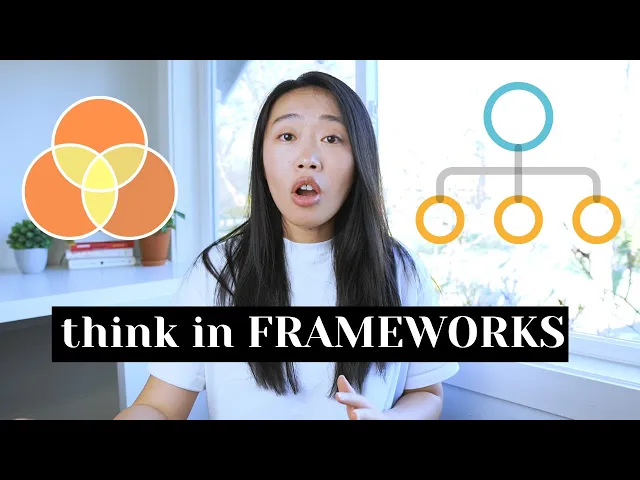
To think fast before you speak, build a mental library of frameworks before you need them. A framework gives your brain a structure to reach for, so you can quickly identify the key factors in a situation, organize your point, and respond without scrambling for words.
watch the video
This article is adapted from my video, How to Think Fast Before You Speak: Framework Thinking. Watch the video if you want the full explanation, then use this page as the skimmable version before your next meeting, Q&A, interview, or difficult conversation.
resources
If you want plug-and-play structures for answering questions, organizing your thoughts, and making concise points at work, 5-Minute Communication Frameworks gives you a repeatable way to stop scrambling and start speaking with structure.
Want one clear-thinking idea in your inbox each week? Join the Speak with Frameworks newsletter for practical ways to think fast, speak smart, and upgrade your mental OS.
the 10-second version
move | what it does | use this when | example |
Create or find frameworks | Turns scattered knowledge into reusable structures | You want to sound clear without memorizing scripts | Ethos, pathos, logos |
Build a mental library | Gives you structures to reach for under pressure | You keep blanking when someone asks a question | Revenue = units sold x price |
Break the problem into levers | Shows you where to focus your answer | A question feels too broad or complex | Profit = revenue - cost |
Connect frameworks | Helps you give deeper answers | You need to move from surface advice to useful diagnosis | Revenue connects to profit, cost, pricing, and demand |
Why Is It Hard to Think on the Spot?
Some people seem like they always know what to say.
They are asked a question in a meeting and answer cleanly. Someone pushes back and they stay composed. The conversation takes an unexpected turn and they can still find the point.
It is tempting to assume they are just smarter, faster, or naturally articulate.
What people miss is that thinking fast usually comes from having better structures ready before the pressure hits.
In the video, I say that many people struggle to steer a conversation because "they don't know what to steer towards." When you are scrambling to think of a point or direction, it becomes much harder to take control.
Framework thinking gives you something to steer toward.
A framework is a structure that helps you organize your thoughts so you can quickly identify the key factors that influence a result. You are not trying to invent a brilliant answer from scratch in real time. You are using a structure to find the most useful part of the answer faster.
Use 4 moves:
Build a mental library of frameworks.
Break broad questions into levers.
Create frameworks by distilling ideas to their essence.
Find hidden frameworks in the ideas you already consume.
How Do Frameworks Reduce Mental Load?
Building a library of frameworks is Vicky’s synthesis for giving yourself a starting structure instead of generating every part of an answer from scratch.
Research on language and working memory supports the underlying constraint: language production and comprehension draw on working-memory systems, and working-memory demands increase as language tasks become more complex.
The study does not test framework thinking itself; it supports the simpler point that answering complex questions in real time places demands on working memory.
step 1: build a mental library of frameworks
The goal of framework thinking is simple: build a mental library of frameworks for the topics that matter to you.
That phrase matters: topics that matter to you.
You do not need a framework for every possible subject. You need frameworks for the rooms you actually enter:
The meetings you lead.
The questions your manager asks.
The decisions your clients care about.
The problems your team keeps returning to.
The ideas you want to be known for.
If you work in marketing, you need frameworks for positioning, customer behavior, demand, offers, messaging, and conversion.
If you lead a team, you need frameworks for priorities, tradeoffs, performance, risk, and decision-making.
If you teach or create content, you need frameworks for attention, learning, transformation, and behavior change.
The more often a topic comes up in your world, the more useful it is to have a framework for it.
In the video, I use revenue as the simplest example:
That one structure gives you an answer path.
If someone asks, "How can my company make more money?" you do not have to chase every possible business idea. You can start with the two levers:
Sell more units.
Increase the price.
That does not mean the answer is easy. It means you know where to begin.
How Do You Turn a Broad Question Into Smaller Levers?
The fastest way to sound clearer is to stop treating big questions as one giant blob.
Most hard questions are made of smaller levers.
"How do we grow?" is too broad.
"How do we improve retention?" is still broad.
"How do we make this presentation more compelling?" is broad too.
Framework thinking asks: what are the levers inside this question?
Research on verbal working memory also shows that verbal information is capacity-limited and that people can combine information into chunks rather than holding every element separately.
That does not mean the study tested Vicky’s “levers” method; it supports the underlying idea that reducing a large problem into a few meaningful units can make the information easier to hold and work with.
The revenue example gives you two levers:
question | framework | levers |
How do we make more money? | Revenue = units x price | Increase units, increase price |
How do we increase profit? | Profit = revenue - cost | Increase revenue, decrease costs |
How do we reduce costs? | Cost = fixed cost + marginal cost | Reduce fixed costs, reduce marginal costs |
Why is the message not compelling? | Ethos, pathos, logos | Credibility, emotion, logic |
Once you see the levers, your answer gets easier.
If someone asks, "How can we increase profits?" you can say:
That answer may not solve the whole problem, but it does something important: it gives the conversation a map.
Now people know where to look.
Which Frameworks Help You Answer Questions in Meetings?
step 3: create frameworks by distilling ideas to their essence
You can find frameworks from books, courses, articles, and smart people around you.
But you can also create them yourself.
That sounds intimidating until you realize what a framework really is: a useful simplification.
In the video, I use Apple's training example with Picasso's bull. Picasso started with a detailed, realistic drawing of a bull. With each iteration, he stripped away more detail until the bull became just a few essential lines.
That is what a good framework does.
It strips away the nonessential details so your brain can hold the shape of the idea.
The goal is not to make the topic shallow. The goal is to make it usable.
For example, if you work in business storytelling, one useful framework is:
Or in plain English:
Credibility.
Emotion.
Logic.
If someone asks why their presentation is not compelling, you can start there:
That is faster than staring at the presentation and saying, "Hmm, something feels off."
Frameworks turn vague judgment into a usable diagnostic.
step 4: find hidden frameworks in the ideas you already consume
Many useful frameworks are hiding in plain sight.
People do not always label them as frameworks. They may call them principles, models, pillars, questions, dimensions, factors, or elements.
Your job is to notice when someone has already condensed a messy topic into a few useful parts.
In the video, I use ikigai as an example.
If someone asks, "How can I make money doing what I love?" that question can feel enormous. But the Japanese concept of ikigai breaks the topic into four elements:
What you love.
What you are good at.
What you can be paid for.
What the world needs.
Now the question has handles.
Instead of giving vague encouragement, you can say:
You may still need deeper expertise to give a great answer. But the framework gets you into the conversation with structure.
That is the point.
Frameworks do not replace thinking. They start the thinking.
step 5: connect frameworks for deeper answers
The real power comes when you start connecting frameworks.
Revenue connects to profit.
Profit connects to cost.
Cost connects to fixed and marginal costs.
Messaging connects to credibility, emotion, and logic.
Career direction connects to skill, market demand, personal energy, and usefulness.
One framework gives you a starting point. Connected frameworks give you range.
This is why Charlie Munger's idea of a "latticework" of mental models is so useful. Isolated facts are hard to use under pressure. Connected models give your knowledge somewhere to live.
At work, this can sound like:
That sounds like quick thinking.
But really, it is structured thinking.
try this before your next meeting
Use this 10-minute framework-building exercise before a meeting where you may need to answer questions on the spot.
Example:
That sentence gives you somewhere to begin.
You can always add nuance later. But under pressure, the first win is having a structure to reach for.
common mistakes
Trying to memorize scripts instead of building reusable structures.
Collecting frameworks but never practicing them in real conversations.
Using frameworks that are too complicated to remember under pressure.
Treating frameworks as the final answer instead of the starting point.
Learning frameworks for random topics instead of the topics that actually come up in your work.
🧪 why this framework
This framework-library approach is Vicky’s synthesis for creating reliable paths through questions that come up repeatedly.
The research cited above supports the underlying constraints: working memory is limited, and language tasks place greater demands on those resources as complexity increases. It does not test Vicky’s framework-library method itself.
The practical implication: do not wait until you are under pressure to organize your thoughts. Build the structure before you need it.
if you enjoyed this...
You might also like: Think Fast and Talk Smart Under Pressure
Speak with frameworks
Get weekly frameworks to upgrade your mental OS